


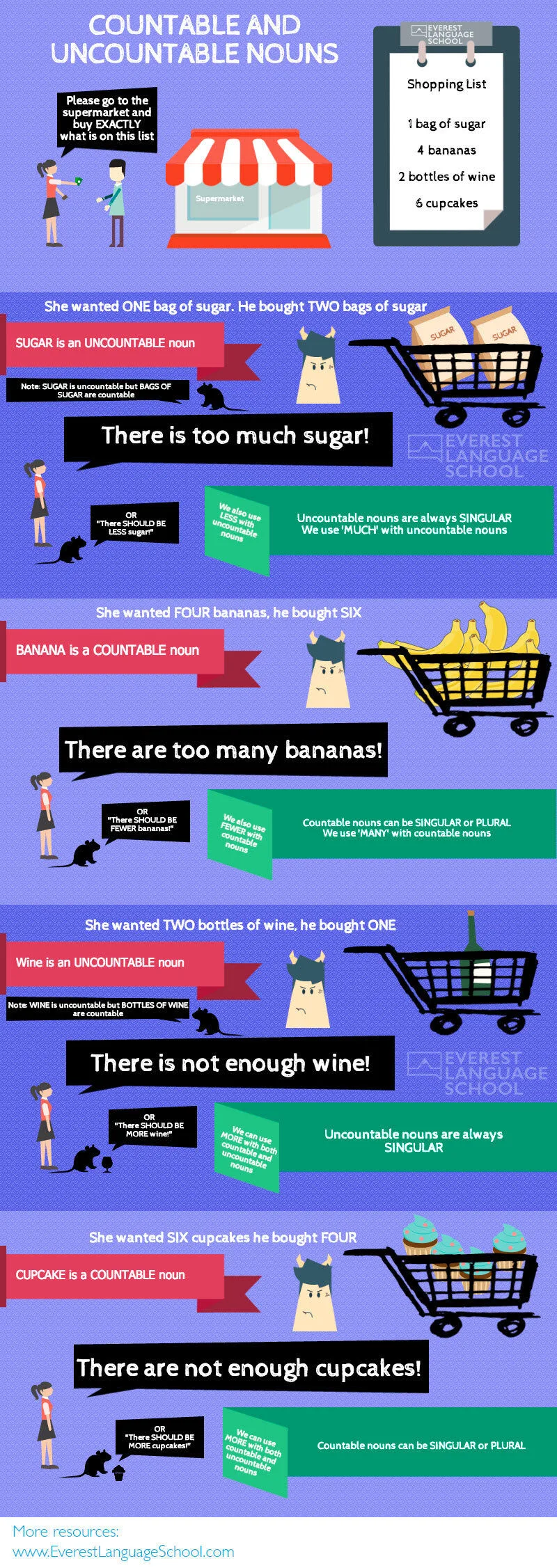

En anglais, il y a parfois trop de règles à suivre. Apprendre une langue peut sembler demander trop de travail, surtout quand on n’a pas assez de temps. Nous avons préparé cette infographie pour vous aider à comprendre et à retenir quelques règles d’emploi de too much, too many et not enough. Si vous avez des questions, posez-les-nous en commentaire, et s’il y a autre chose que vous aimeriez que nous expliquions, dites-le-nous ci-dessous.
TOO MUCH, TOO MANY et NOT ENOUGH : trop et pas assez en anglais
TOO MUCH et TOO MANY
On emploie TOO MANY + NOM DÉNOMBRABLE
On emploie TOO MUCH + NOM INDÉNOMBRABLE
There are too many books in granddad’s house!
The boy has put too much sugar on his grapefruit!
NOT ENOUGH
There is not enough sugar in my coffee
There are not enough chairs
LA SAGESSE DU SHERPA : notez qu’ENOUGH se place AVANT un NOM
TOO
On emploie Too + un ADJECTIF
The boy is too small to ride the rollercoaster = The boy is not tall enough to ride the rollercoaster
LA SAGESSE DU SHERPA : notez qu’ENOUGH se place APRÈS un adjectif
TROP ET PAS ASSEZ : ERREURS FRÉQUENTES
The coffee is too much hot for me The coffee is too hot for me
I like Dublin too much I like Dublin a lot/ I really like Dublin
I am too much happy I am very happy/ I am really happy