








IELTS Task 1 Band 9
A continuación tienes un ejemplo de pregunta de IELTS Task 1 y una respuesta modelo. Se estima que esta respuesta obtendría un Band 9. Primero lee la respuesta y después la analizamos en detalle.
Fuente: IELTS Buddy
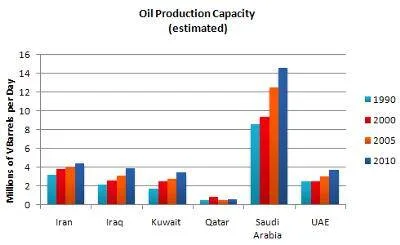
The table below shows the estimated oil capacity of six countries, in millions of barrels per day, from 1990 to 2010.
Summarise the information by selecting and reporting the main features, and make comparisons where relevant.
You should spend about 20 minutes on this task.
Write at least 150 Words.
Respuesta modelo
The bar chart illustrates the estimated amount of oil produced in 6 countries between 1990 and 2010, measured in millions of barrels per day.
Overall, oil production capacity tended to increase during this 20-year period. The figures for Saudi Arabia were significantly higher than in the other countries, while production was lowest in Qatar.
From 1990 to 2010, there was a significant increase in oil production in Saudi Arabia. In 1990, just over 8 million barrels per day were produced and this rose steadily, reaching a peak of over 14 million barrels per day in 2010. In contrast, the smallest producer was Qatar. Despite a slight increase in 2000, production in Qatar remained relatively stable at less than 1 million barrels per day.
The other countries saw a slight rise in oil production over the period. The estimated figure for Iran in 1990 was over 3 million barrels per day, compared with around 2 million barrels in the other three countries. Although production did not increase in 2000 in the UAE, the amount of oil produced peaked in 2010 in Iran at over 4 million barrels and at almost 4 million barrels in Iraq, Kuwait and the UAE.
(198 palabras)
Puntuación IELTS Task 1: Band 9
Task Achievement (cumplimiento de la tarea): 9
Coherence & Cohesion (coherencia y cohesión): 9
Lexical Resource (vocabulario): 9
Grammar (gramática): 9
Puntuación global: Band 9
Análisis
Párrafo 1
El primer párrafo recoge toda la información clave del gráfico, pero parafrasea el enunciado. Esto es muy importante: usa sinónimos y reformula con tus propias palabras. Por ejemplo, en este caso:
“shows” pasa a “illustrates”
“oil capacity” pasa a “amount of oil”
“from 1990 to 2010” pasa a “between 1990 and 2010”
Párrafo 2
Este párrafo ofrece una visión general clara del gráfico. La tendencia general es que la capacidad aumentó, aunque hay una gran diferencia entre Arabia Saudí y Catar. El párrafo demuestra un dominio excelente de la gramática y el vocabulario necesarios: “Tended to increase”; “20-year period” (y no 20-year s period); “significantly higher than”.
Párrafo 3
Este párrafo entra en detalle sobre los dos países más destacados: Arabia Saudí y Catar. Sigue con claridad al párrafo anterior, que ya había señalado estos dos países. Todo el vocabulario clave para describir la evolución de un gráfico se usa correctamente (“significant increase”; “rose steadily”; “reaching a peak”; “remained relatively stable”). Hay dos frases sobre Arabia Saudí y otras dos sobre Catar, unidas correctamente con el conector “in contrast”. El párrafo está muy bien estructurado y es cohesivo, sin errores gramaticales y con una excelente variedad de vocabulario.
Párrafo 4
El párrafo 4 da detalles sobre los otros cuatro países. De nuevo, todo el lenguaje para describir un gráfico es preciso: “saw a slight rise”, “peaked in 2010”. Las preposiciones también se usan correctamente (algo que los estudiantes suelen confundir): “a rise in production”, “ in 1990”, “compared with” , “peaked in 2010 in Iran at over 4 million barrels”
Conclusión
Esta respuesta reúne todo lo necesario para obtener un Band 9 en IELTS Task 1. Es clara y está bien estructurada, con un uso hábil de los párrafos y los conectores. Incluye una amplia variedad de vocabulario muy natural para describir un gráfico y no tiene faltas de ortografía. Tampoco hay errores gramaticales y presenta una excelente variedad de estructuras complejas.
Criterios de corrección de IELTS Task 1:
Descriptores de puntuación de IELTS Task 1 Writing (PDF)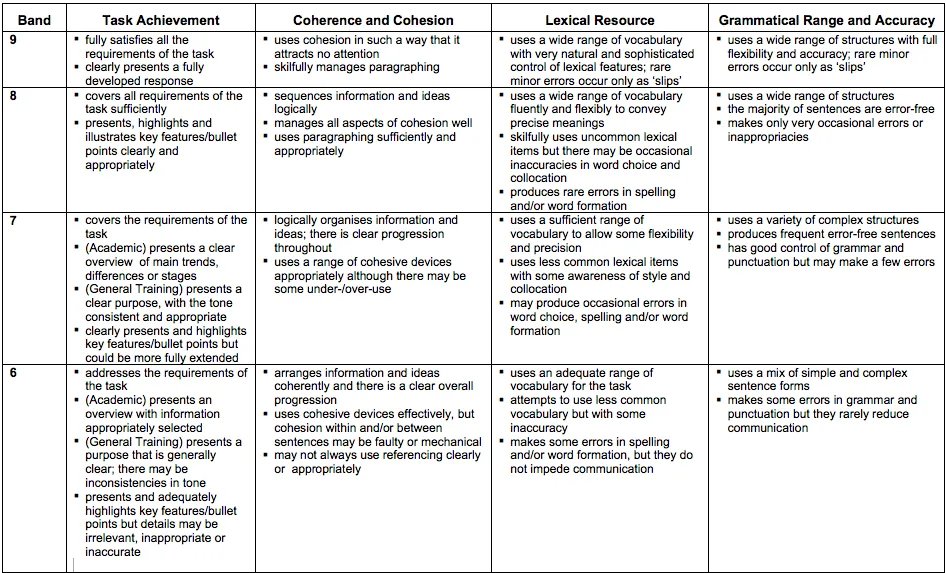
Este artículo es de Conor Reid, profesor de Everest Language School y creador de un podcast literario
Puedes prepararte para el examen IELTS en Dublín en uno de nuestros cursos de IELTS Preparation.