



Quelques points avancés sur les articles définis et indéfinis :
Les catégories (registre soutenu) : The tiger is threatened with extinction.
Pour désigner l’œuvre d’un artiste : My mother found a Salvador Dali in the attic.
Les groupes nationaux : The Irish are known to be great writers and drinkers.
Dans les mesures, « a/an » peut remplacer « per » : If petrol costs €1 a litre and your car is travelling at 50 miles an hour, how much will it cost to drive for 10 miles?
Certains groupes au pluriel (politiques, musicaux ou autres) : The government is evenly divided between the Social Democrats and the Green Party.
Pour nommer un métier : Otavio hopes to be a cosmonaut when he grows up.
Les objets uniques : Which is further from earth, the sun or the moon?
Pour souligner qu’une personne est inconnue : Miss Moneypenny said to Mr. Bond “a Mr. Evil called while you were saving the world”.
Pour les titres et fonctions (souvent uniques) : Anne Marie is the Director of Studies in our school.
Les noms de journaux (« The » prend une majuscule) : The Irish Times gives more accurate information than the Sun.
On utilise « the » pour parler de jouer d’un instrument : Ko is learning how to play the bassoon.
Devant le nom d’une université seulement s’il est suivi d’un complément : He studied in the University of Chicago, but his girlfriend studied in Oxford University.
Article zéro devant « most » quand il signifie « la majorité » : Most Americans can’t point out Paris on a map.
« The » se place devant « most » quand il s’agit d’un superlatif : Paris is the most romantic city in Europe.
LA PRONONCIATION DES ARTICLES
Il y a quelques points à retenir sur la prononciation des articles. On utilise « a » devant un son consonne et « an » devant un son voyelle. Écoute le son, ne regarde pas seulement l’orthographe. On dit donc : « An effect » et « an FBI agent », car les deux commencent par le son /e/. On dit : « A yellow submarine » et « a European », car les deux commencent par /j/.
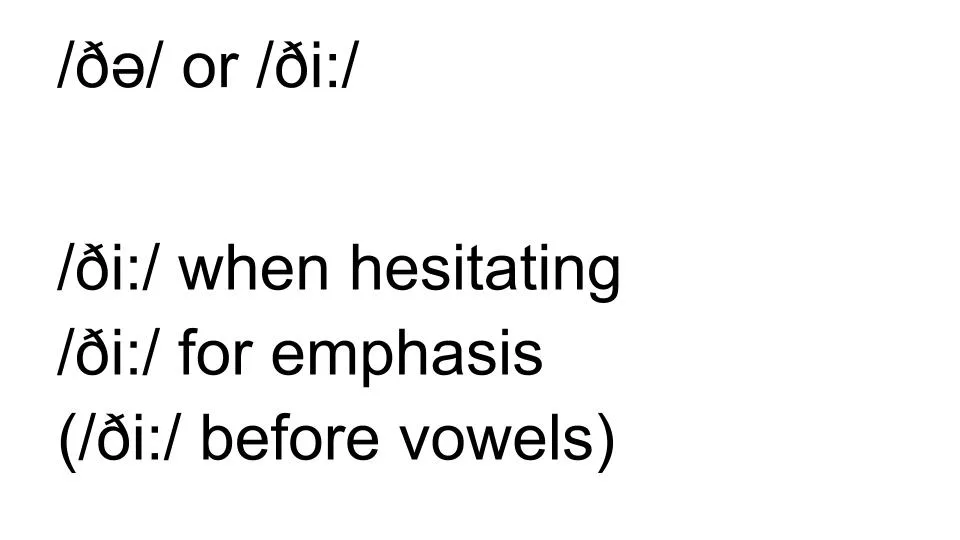
Il existe deux façons de prononcer « the ». Dans 90 % des cas, on dit : /ðə/. Dans certains cas exceptionnels, on prononce « the » comme « thee » ( /ði:/ ).