





Quelques points avancés sur l’article en anglais, défini et indéfini :
Les catégories (registre soutenu) : The tiger is threatened with extinction.
Pour désigner l’œuvre d’un artiste : My mother found a Salvador Dali in the attic.
Les groupes nationaux : The Irish are known to be great writers and drinkers.
Dans les mesures, « a/an » peut remplacer « per » : If petrol costs €1 a litre and your car is travelling at 50 miles an hour, how much will it cost to drive for 10 miles?
Certains groupes au pluriel (partis politiques, groupes de musique, etc.) : The government is evenly divided between the Social Democrats and the Green Party.
Pour nommer un métier : Otavio hopes to be a cosmonaut when he grows up.
Les choses uniques : Which is further from earth, the sun or the moon?
Pour souligner qu’une personne est inconnue : Miss Moneypenny said to Mr. Bond “a Mr. Evil called while you were saving the world”.
Les fonctions (souvent uniques) : Anne Marie is the Director of Studies in our school.
Les titres de journaux (« The » prend une majuscule) : The Irish Times gives more accurate information than the Sun.
« The » pour parler de la capacité à jouer d’un instrument : Ko is learning how to play the bassoon.
Le nom d’une université, seulement s’il est suivi d’un complément : He studied in the University of Chicago, but his girlfriend studied in Oxford University.
Article zéro devant « most » quand il signifie « la majorité » : Most Americans can’t point out Paris on a map.
« The » se place devant « most » au superlatif : Paris is the most romantic city in Europe.
LA PRONONCIATION DES ARTICLES
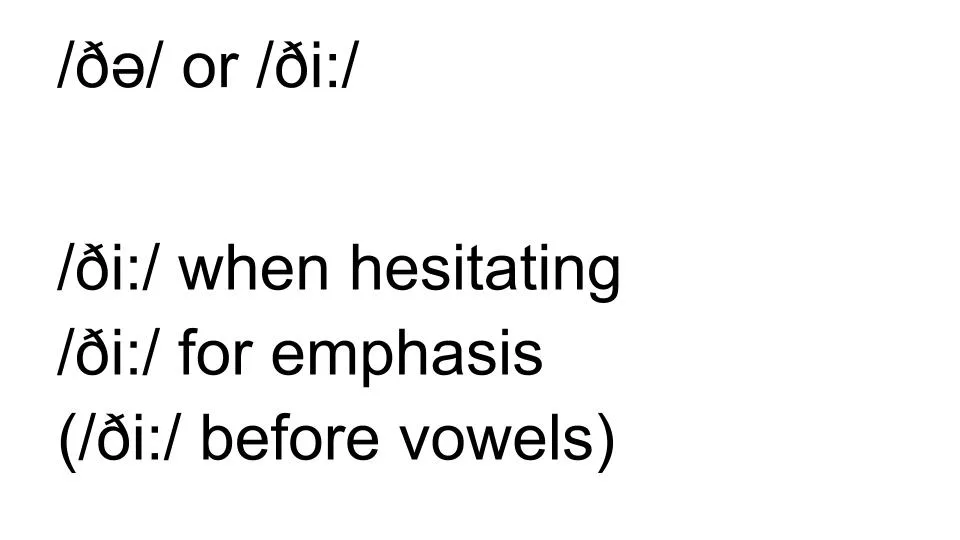
Voici quelques points à retenir sur la prononciation des articles. On utilise « a » devant un son consonne et « an » devant un son voyelle. Il faut écouter le son, et pas seulement regarder l’orthographe. On dit donc « an effect » et « an FBI agent », car les deux commencent par le son /e/. Et on dit « a yellow submarine » et « a European », car les deux commencent par /j/.
Il y a deux façons de prononcer « the ». Dans 90 % des cas, on dit /ðə/. Dans certains cas exceptionnels, on prononce « the » comme « thee » (/ði:/).